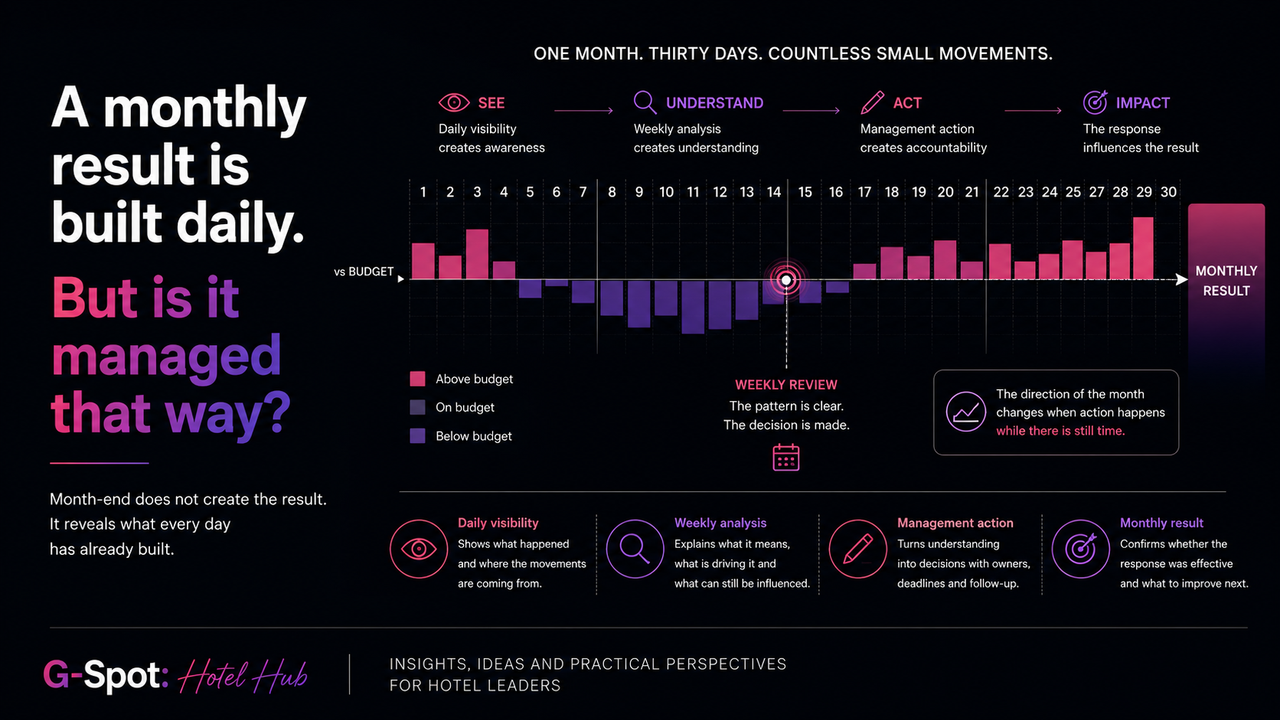
Hotel performance rarely changes all at once. It moves gradually, through a series of daily variations that may appear insignificant when viewed in isolation.
A weaker Monday occupancy, a stronger ADR on Tuesday, fewer restaurant covers on Wednesday or a decline in SPA treatment volume can each look like separate operational events. Over time, however, these movements begin to shape the monthly result.
Most hotels already have access to this information. Daily reports are produced, departmental figures are circulated and performance is discussed in morning meetings. Yet many management teams still reach the end of the month facing results that feel more surprising than they should.
The issue is not always a lack of data. More often, it is the absence of a clear process for connecting daily performance with weekly management decisions.
Daily figures do not automatically create daily management
Reviewing yesterday’s results is useful, but it does not necessarily mean that performance is being actively managed.
A daily report may show that occupancy was below budget, restaurant revenue declined or payroll remained high against lower business volume. These observations are important, but on their own they provide only a snapshot.
The real value appears when the team starts connecting those daily movements.
Was the weak occupancy limited to one day, or is it becoming a weekday pattern? Did restaurant revenue fall because the hotel had fewer guests, because capture declined or because spend per cover weakened? Is SPA revenue holding because treatment demand remains healthy, or because retail sales are temporarily compensating for a lower number of treatments?
Without that level of interpretation, daily reporting can easily become a routine exercise. The figures are reviewed, comments are made and the next day brings a new set of numbers. The hotel remains informed, but not necessarily in control.
The week is where the pattern becomes visible
Daily performance tells the team what happened. Weekly analysis helps explain what it means.
This is an important distinction because one poor day may be an exception, while several similar days may indicate a developing issue. A single drop in ADR may be linked to a group arrival or a deliberate pricing decision. A repeated decline across several weekdays may point to a broader problem in demand, segmentation or commercial strategy.
The same applies outside Rooms. In F&B, a weekly revenue decline may be caused by lower hotel occupancy, fewer external guests, weaker capture or lower average spend. In SPA, stable revenue can hide a reduction in treatment volume if higher-value packages or retail sales are compensating for it.
A weekly review should therefore do more than compare totals against budget and last year. It should help the team understand which days, departments and KPIs created the movement, whether the issue is temporary or becoming a pattern, and what can still be influenced before the month closes.
That is where reporting begins to become management.
Many weekly meetings still focus too heavily on explanation
Hotel performance meetings often contain a great deal of information, but not always enough direction.
Department heads explain why the previous week performed as it did. Revenue is reviewed, variances are discussed and operational challenges are shared. The meeting may be informative, yet still finish without a clear agreement on what happens next.
This is usually where the value is lost. A performance gap should lead to a decision, not only an explanation. If weekday occupancy is weakening, what will be changed in pricing, distribution or commercial activity? If breakfast spend per guest is declining, who will review the offer, capture and upselling approach? If payroll is not moving with business volume, what action will be taken and when will the impact be reviewed?
Without clear ownership and follow-up, even a correct diagnosis has limited value.
The purpose of the weekly review is not to produce a perfect explanation of the past. It is to decide how the hotel will respond while the outcome can still be influenced.
Month-end should confirm the story, not reveal it
Monthly reporting remains essential. It provides the complete financial picture and supports ownership reporting, forecasting, budgeting and long-term analysis. However, month-end should not be the first moment when the management team fully understands what happened.
By the time the month closes, most short-term options have disappeared. The hotel can explain the result, but it can no longer change it. Pricing decisions, staffing adjustments, purchasing controls and commercial actions that might have helped two or three weeks earlier are no longer available.
A strong management process should make the final monthly result feel familiar. The team should already know which departments are ahead or behind, which KPIs are driving the movement and which actions have been taken. The month-end report then confirms the outcome of a story that has been understood and managed throughout the month.
When the final result comes as a surprise, the problem is often not what happened in the last few days. It is that the earlier signals were not connected quickly enough.
From visibility to action
This is the thinking behind G-App.
The objective is not simply to provide another place to view hotel data. It is to connect the daily performance breakdown with the way management teams review and act on results during the week.
G-App allows teams to examine the daily performance of Rooms, F&B and SPA, compare results across relevant periods and understand which days and KPIs are shaping the month.
That daily detail becomes more valuable during the weekly review. Instead of discussing only high-level totals, the team can identify where the gap started, what is driving it and whether it is an isolated event or part of a broader pattern.
Amalia adds another layer by helping highlight the areas that deserve attention first. It can support the analysis, but the final value still depends on the quality of the management conversation that follows.
Technology can make the signal clearer and reduce the time needed to find it. The team still needs to decide what to do, who owns the action and when the result will be reviewed.
Managing the result before it becomes history
Daily visibility, weekly analysis and management action should not be treated as separate activities. They are parts of the same performance cycle.
The daily breakdown provides the detail needed to understand where results are being created. The weekly review gives management the opportunity to connect those individual movements, distinguish isolated events from developing patterns and decide which areas require a response. The actions that follow then determine whether the hotel can influence the direction of the month before the remaining options disappear.
This is why the quality of hotel reporting should not be measured only by how accurately it explains the past. Its real value lies in how effectively it supports decisions about what happens next.
A management team that understands the daily drivers of performance is less likely to be surprised at month-end. It already knows where the main variances are coming from, what has been done in response and whether those actions are beginning to have an effect.
The monthly result then becomes the conclusion of a process that has been actively managed, rather than the first complete explanation of what went wrong.
Hotels do not miss budget on the final day of the month. The result develops gradually through changes in demand, pricing, guest behaviour, productivity and departmental performance. The earlier those movements are understood, the more opportunity management still has to influence the outcome.
That is the connection G-App is designed to support: detailed daily visibility, more focused weekly analysis and better-informed decisions throughout the month.
See the day. Understand the week. Influence the month.
